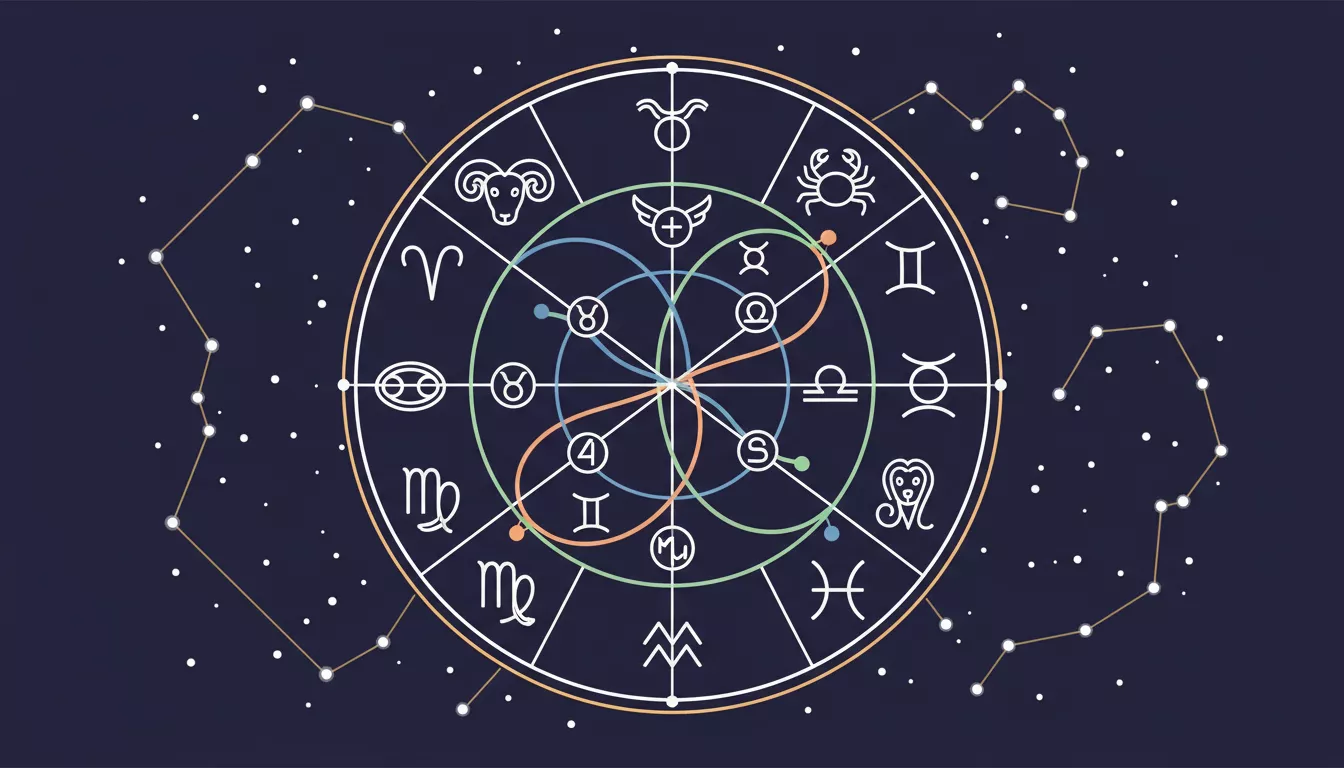
Celestial birth chart wheel with zodiac symbols arranged in a circle and planetary alignment paths crossing the center against a deep purple starfield
๐ŸŒŒ

โ˜… Birth Chart Guide โ˜…

How to Read Your Natal Chart

Planets ยท Signs ยท Houses ยท Aspects

โ˜… What Is a Birth Chart?

A birth chart - sometimes called a natal chart - is basically a map of the sky at the exact moment you were born. It shows where every planet was sitting, which zodiac sign each planet was passing through, and which section of the sky (called a house) it occupied. If your sun sign is like your headline, your birth chart is the full article.

Most people only know their sun sign - the sign determined by their birthday. And that's a perfectly fine starting point. But it only tells you about one planet out of ten. Your birth chart reveals why you might be a Taurus who doesn't act like a "typical" Taurus, or why two Leos you know seem completely different from each other. The other planets, signs, and houses fill in the rest of the picture.

To create your birth chart, you need three things: your date of birth, your time of birth (as exact as possible), and your place of birth. The date gives you the planetary positions. The time determines your rising sign and house placements. And the location adjusts everything based on where on Earth you were when the sky looked that specific way.

โ˜… The Planets: What They Represent

Each planet in your birth chart rules a different part of your personality and life. The inner planets (Sun through Mars) move quickly and shape your day-to-day personality. The outer planets (Jupiter through Pluto) move slowly and influence broader life themes shared by your generation.

Personal Planets

โ˜‰ The Sun

Rules: Core identity, ego, life purpose, vitality. Your sun sign is the foundation of who you are - your basic character and the energy you naturally radiate. When someone asks "what's your sign?", this is what they mean. Find your sun sign here.

โ˜ฝ The Moon

Rules: Emotions, instincts, comfort needs, inner self. Your moon sign describes the you that comes out behind closed doors. It's how you process feelings, what makes you feel safe, and what you need when the world gets too loud. Many astrologers consider it just as important as your sun sign.

โ˜ฟ Mercury

Rules: Communication, thinking style, learning, daily expression. Mercury shapes how you talk, write, process information, and make decisions. A Mercury in Gemini person thinks in rapid-fire bursts, while Mercury in Taurus takes their time and speaks deliberately.

โ™€ Venus

Rules: Love, beauty, values, pleasure, money. Venus determines your love language - how you express and want to receive affection. It also shapes your aesthetic taste and relationship with material comforts. In compatibility readings, Venus is one of the most important planets to compare.

โ™‚ Mars

Rules: Drive, ambition, anger, passion, physical energy. Mars is your engine. It determines how you chase what you want, how you fight, and what gets your blood pumping. Mars in Aries charges in headfirst. Mars in Cancer protects and defends the people they love.

Social and Outer Planets

โ™ƒ Jupiter

Rules: Growth, luck, expansion, wisdom, philosophy. Jupiter is the planet of abundance - wherever it sits in your chart, that area of life tends to come more easily to you. It spends about a year in each sign, so it colors your generation's approach to growth and opportunity.

โ™„ Saturn

Rules: Discipline, responsibility, limits, maturity, life lessons. Saturn is the strict teacher of the zodiac. It points to areas where you'll face challenges and need to put in extra work. But those hard-won Saturn lessons become your greatest strengths over time. The famous "Saturn return" around age 29 is when many people experience a major life shift.

โ™…โ™†โ™‡ Uranus, Neptune, Pluto

Rules: Generational themes. These three outer planets move so slowly they spend years or decades in each sign. Uranus (rebellion, innovation) stays 7 years. Neptune (dreams, spirituality) stays about 14 years. Pluto (transformation, power) can stay in a sign for 12-30 years. They shape the collective values of entire age groups rather than individual personality. All three spend about five months each year in retrograde, turning their transformative energy inward.

โ˜… The 12 Houses: Where It All Plays Out

If planets are the what and signs are the how, houses are the where. Your birth chart is divided into 12 sections, each ruling a different area of life. The house a planet sits in tells you where that planet's energy shows up most strongly. Your rising sign determines which sign rules your first house, and the rest follow in order around the wheel. For an in-depth look at each house, see our complete guide to the 12 astrological houses.

1st House โ€” Self

Your appearance, first impressions, and how you present yourself to the world. Ruled by your Ascendant (rising sign). This is the mask you wear before people get to know the real you.

2nd House โ€” Money & Values

Income, possessions, self-worth, and what you value. Planets here shape your relationship with money and material security.

3rd House โ€” Communication

Thinking, talking, writing, short trips, and siblings. This house reflects your daily mental life and how you connect with your immediate environment.

4th House โ€” Home & Family

Your roots, childhood, mother figure, and sense of belonging. The IC (Imum Coeli) sits at the cusp and represents your deepest private self.

5th House โ€” Creativity & Joy

Romance, fun, hobbies, children, and creative expression. This is where you play and what brings you genuine pleasure.

6th House โ€” Health & Work

Daily routines, health habits, work environment, and service to others. Not your career (that's the 10th) but your day-to-day grind and wellness.

7th House โ€” Partnerships

Marriage, business partnerships, and one-on-one relationships. The Descendant sits here, representing qualities you're attracted to in others.

8th House โ€” Transformation

Shared resources, intimacy, death and rebirth, psychology, and other people's money. This is the house of deep change and things hidden below the surface.

9th House โ€” Philosophy

Higher education, travel, religion, law, and big-picture meaning. Where the 3rd house handles local knowledge, the 9th seeks universal truth.

10th House โ€” Career & Legacy

Public reputation, career ambitions, authority figures, and your legacy. The Midheaven (MC) sits at the cusp and is one of the most career-relevant points in any chart.

11th House โ€” Community

Friendships, groups, hopes, and humanitarian ideals. This house governs your social networks and long-term aspirations for making the world better.

12th House โ€” The Unseen

Subconscious, spirituality, hidden enemies, solitude, and self-undoing. The most mysterious house - it represents everything that operates behind the scenes in your psyche.
โ˜… Your Big Three: The Most Important Placements

If you're just getting into birth charts, start with your "Big Three." These three placements give you the broadest and most accurate sketch of who you are. Most astrologers consider them the foundation of any chart reading.

โ˜‰ Sun Sign โ€” Your Core Identity

This is the sign you already know - it's based on your birthday. Your sun sign represents your fundamental character, the traits you build your life around, and the energy you're here to express. It's your conscious self. Calculate your sun sign if you're not sure of yours.

โ˜ฝ Moon Sign โ€” Your Emotional Self

Your moon sign is your inner world. It governs your emotional reactions, instincts, and what you need to feel safe and nurtured. A Scorpio moon feels things intensely and struggles to let go. A Sagittarius moon processes emotions through humor and adventure. Your moon sign often explains why your horoscope doesn't always feel right - you might resonate more with your moon sign's description.

โ†‘ Rising Sign (Ascendant) โ€” Your Outer Self

Your rising sign is the zodiac sign that was climbing over the eastern horizon at the exact minute you were born. It shapes your appearance, your vibe, and the first impression you make on people. It's also why your birth time matters so much - the rising sign changes roughly every two hours. A Libra rising comes across as charming and put-together, even if their sun sign is more introverted. A Capricorn rising appears serious and composed, even if they're secretly a goofball.

โ˜… Aspects: How Your Planets Talk to Each Other

Aspects are the angles formed between two planets in your chart. They determine whether those planets work together easily or create internal tension. Some aspects feel like a natural flow, others feel like an ongoing internal argument. Both have value - the challenging aspects often push you to grow in ways the easy ones never would.

โ˜Œ Conjunction (0ยฐ)

Two planets sitting right next to each other. Their energies fuse together - for better or worse. A Sun-Jupiter conjunction amplifies confidence. A Moon-Saturn conjunction can mean deep emotional seriousness.

โ–ณ Trine (120ยฐ)

The easiest aspect. Planets in trine flow naturally, sharing the same element. Talents come effortlessly here, but the risk is taking these gifts for granted and never pushing to develop them fully.

โ–ก Square (90ยฐ)

Tension and friction. Squares create internal conflicts that demand resolution. They're uncomfortable but productive - most people's greatest achievements are powered by square energy. Growth rarely happens without some friction.

โ˜ Opposition (180ยฐ)

A tug-of-war between two planets. Oppositions ask you to find balance between competing needs. Like the opposite signs, there's a magnetic quality to this tension that, once integrated, creates remarkable wholeness.

โšน Sextile (60ยฐ)

A gentle, supportive connection. Sextiles represent opportunities and compatible energies, but unlike trines, they require a bit of effort to activate. Think of them as doors that are open - you still have to walk through them.

No Major Aspect

When planets don't form major aspects to each other, they operate independently. This isn't necessarily bad - it just means those parts of your life run on separate tracks without much cross-influence.

โ˜… How to Read Your Birth Chart Step by Step

Reading a full birth chart can feel overwhelming at first. There are planets, signs, houses, and aspects all tangled together. Here's a practical approach to make sense of it without getting lost.

1

Start With Your Big Three

Look up your Sun, Moon, and Rising signs first. Read about each one individually. Notice where they agree and where they clash. This trio alone gives you a surprisingly accurate personality profile.

2

Check Where the Planets Are Clustered

If several planets are grouped in the same sign or house, that area of life gets extra emphasis. Three planets in Virgo? You're probably extremely detail-oriented. Multiple planets in the 7th house? Relationships are a central theme of your life.

3

Look at Venus and Mars

For relationship insights, these are your go-to planets. Venus shows how you love. Mars shows how you pursue and assert. Together they paint a detailed picture of your relationship style and what you're attracted to.

4

Note the Challenging Aspects

Squares and oppositions point to your growth areas. Don't be discouraged by them - these are the parts of your chart that push you to become stronger. A chart with no difficult aspects would belong to someone who never grows.

5

Check Your Element Balance

Count how many planets you have in each element. Heavy on fire? You're action-oriented. Lots of water? You lead with emotions. Missing an element entirely? That area might feel like a blind spot you compensate for in other ways.

โ˜… Frequently Asked Questions

What is a birth chart in astrology?

A birth chart (also called a natal chart) is a map of where every planet was positioned at the exact moment you were born. It shows the zodiac sign and house placement for the Sun, Moon, Mercury, Venus, Mars, Jupiter, Saturn, Uranus, Neptune, and Pluto. Think of it as a snapshot of the sky from your specific birth location and time.

What information do I need to create a birth chart?

You need three pieces of information: your date of birth, your exact time of birth (as close as possible), and your place of birth. The date determines your sun sign and planetary positions. The time determines your rising sign and house placements. The location helps calculate the exact positions based on your geographic coordinates.

What is the difference between a sun sign and a birth chart?

Your sun sign is just one piece of your birth chart - it's where the Sun was positioned when you were born. A birth chart includes all the planets, the rising sign (ascendant), the 12 houses, and the angles (aspects) between planets. Reading your full birth chart gives a much more detailed and accurate picture than your sun sign alone.

What are the most important placements in a birth chart?

The three most important placements are called your "Big Three": Sun sign (core identity), Moon sign (emotional nature), and Rising sign or Ascendant (how others see you). After those, Venus (love style), Mars (drive and passion), and Mercury (communication style) are the next most personally relevant placements to explore.

Find Your Sun Sign

Start exploring your birth chart by discovering your Western zodiac sign and Chinese zodiac animal with our free calculator.

Try the Calculator โ†’